
One thing we can all agree on is that no one needs another meeting for its own sake.
We’re running businesses. There are customer relationships to maintain, staff to manage, cashflow to consider, problems arising and decisions that need to be made.
If you run a business, think back to the last ad-hoc meeting you had with your accountant. Did it move the business forward, or was it mostly a pleasant catch-up with no clear actions afterwards?
Done well, a quarterly review with your accountant should be a structured, practical and useful conversation that helps you step back from the day-to-day, understand what is happening in the business, and make better decisions before issues become urgent.
It is part of moving from a reactive accountancy relationship to a more proactive one.
The year-end accounts compliance cycle is still there, but for us, that is part of the basics, the foundation of the relationship. It is not very strategic if the only time a business owner has a meaningful conversation with their accountant is to go through end of year accounts and tax returns that tell a story up to 18 months old.
By then, many of the best opportunities to plan, adjust or act have already passed.
Quarterly progress reviews are not generic business coaching sessions
A good quarterly meeting should be tailored to the business.
For one client, that might mean focusing on cashflow, margins and debtor days. For another, it might be director remuneration, corporation tax exposure and upcoming capital expenditure. Or it might be growth plans, funding, staffing, group structure or succession.
The point is not to talk through a generic checklist.
The point is to use the meeting to focus on the areas that matter most. It should still be grounded in accounting, tax and the financial reality of the business. The value comes from connecting the numbers, the tax position and the owner’s plans in one structured conversation with someone who deeply understands the finances as well as the commercials.
How we structure the meeting to add more value
A progress review should not become the place where everyone first discovers the issues. If that happens, too much time is lost and the agenda is often hijacked.
The better approach is to review the relevant information beforehand, there should be some pre-work. That might include reviewing recent figures, looking at the management information available, considering tax deadlines, reviewing open questions, and asking the client to think about what is changing in the business.
That means the meeting can be used for discussion, interpretation and decisions, rather than simply trying to work out what the problems are.
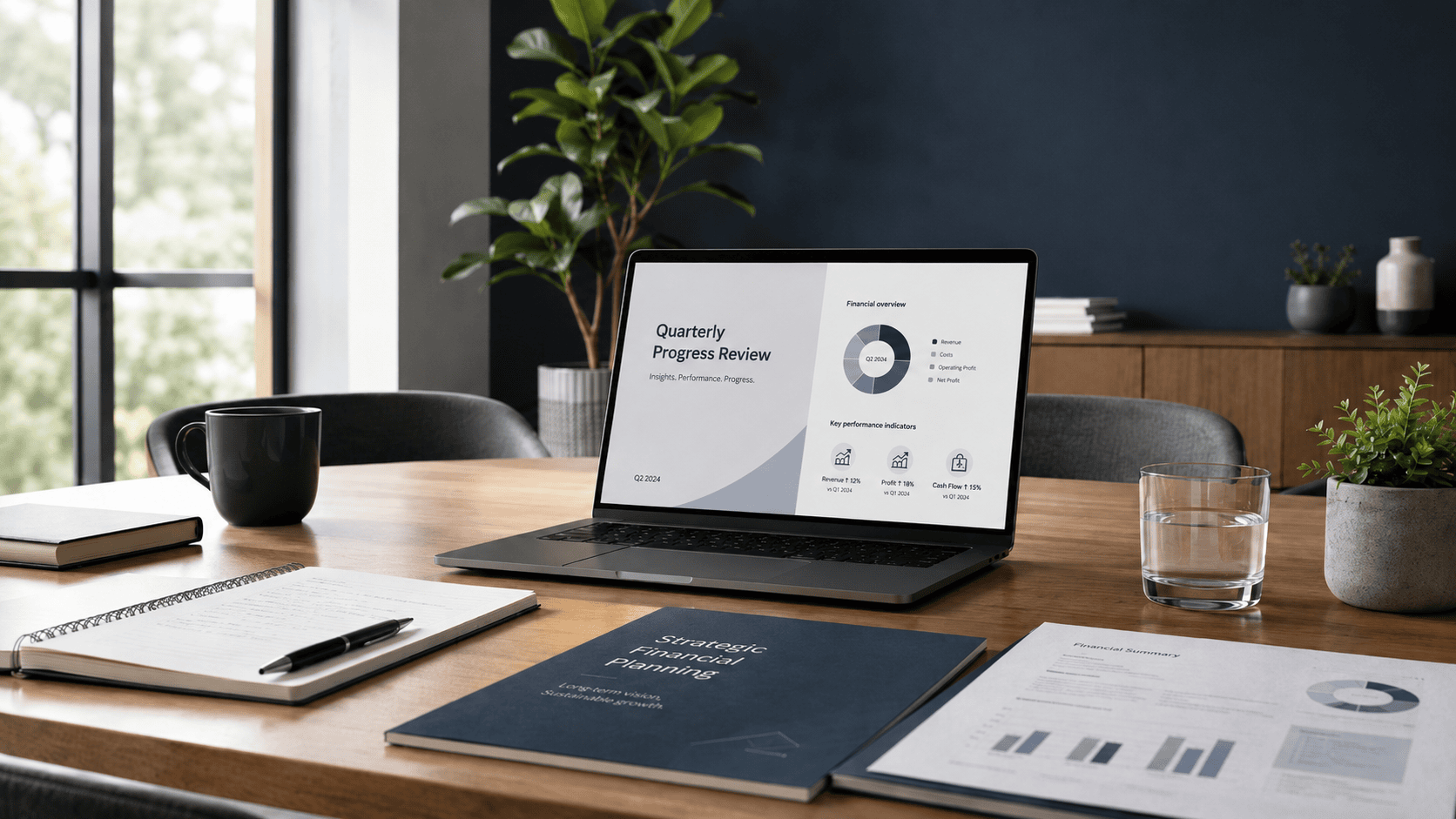
Where appropriate, we prepare a tailored slide deck for the meeting. The deck can bring together the key numbers, tax considerations, current issues, discussion points and agreed agenda in one place. It also means the client is not left trying to piece together the conversation from memory afterwards.
A good progress meeting should feel prepared. Not over-engineered, but prepared.
The client should not be left wondering what the meeting was for, why a particular point was raised, or what happens afterwards.
Getting out of the day-to-day changes the conversation
We encourage local clients to come to us for these meetings.
We find there is a different quality of conversation when a business owner physically steps away from their usual working environment.
Most owner-managed businesses are busy, reactive places.
There is always an email to answer, a customer to call back, a team member needing a decision, or an operational issue pulling attention back into the day-to-day.
That environment is not always ideal for thinking properly about the direction of the business.
Taking time away from the office, workshop, site or desk can help the owner look at things differently, more strategically. The business is still there, but the constant noise is not.
We can still deliver the same value in a virtual meeting; the timing just becomes more important. We want to avoid sandwiching it between two other calls that results in a rush onto the call and one eye on the clock for the next one.
Some of the most useful conversations are not about one specific technical answer. They come from giving the owner room and supporting them to think clearly about what is actually happening and what needs to happen next.
The numbers should be reviewed while they are still useful
The annual accounts are important and do provide insight, but they are backward-looking. They tell you what happened, which is not necessarily what is happening now.
Financial information is most useful when it can still affect decisions.
A quarterly review creates a natural opportunity to look at areas such as:
- revenue and gross margin
- profit trends
- cashflow
- debtor balances
- tax liabilities
- director drawings
- upcoming investment
- funding needs
- budget setting and forecasting
- risks, opportunities and pressure points
The conversation does not need to become overly complicated. Most business owners do not need to be buried in dashboards or technical analysis.
They need to understand the right information.
Is the business performing as expected? Are margins moving? Is cash following profit? Are drawings sustainable? Are tax liabilities being considered? Are there decisions coming up that are time-critical before the year-end?
These questions are much more useful during the year than after it.
A business can look profitable on paper and still feel tight for cash. Growth can also bring more exposure, even where sales look strong. Margins may be quietly weakening, or small issues may be building into problems that become more expensive if left alone.
A quarterly progress review helps bring those conversations forward.
Tax planning is effective before a decision is made
Tax advice is often at its most valuable before a transaction, decision or deadline.
Once something has already happened, the options may be narrower.
That is why regular conversations with your accountant can be so important. They create more chances to identify tax points at the right time.
That might include:
- corporation tax visibility
- dividend planning
- director remuneration
- capital expenditure
- VAT and PAYE cashflow
- use of losses or reliefs
- group structure and losses
- business acquisitions or disposals
- succession planning
- broader year-end planning points
- budget setting
Not every quarterly meeting will involve major tax planning. Sometimes the answer is simply to keep the position under review and make sure nothing obvious is being missed.
But when there is something significant coming up, it can often be time sensitive.
The best tax advice won’t happen months after the event. It is far more useful when it helps the business owner understand the consequences before committing.
Business decisions have accounting and tax consequences
How often have you called your accountant to say “I’ve just spent X, or I’ve just committed to Y” for them to say ‘I wish you’d told me that before, we could have done A, B or C’.
This is the result of not building and embedding a proactive relationship.
A commercial decision can affect cashflow. A funding decision can affect tax. A remuneration decision can affect both the company and the director personally. A new project, asset purchase, restructure or succession plan can create accounting, tax and practical commercial consequences at the same time.
A quarterly progress review is a useful place to connect those threads, explore the ideas and keep decisions grounded in strategy rather than knee-jerk reactions.
It allows the owner to say, “We are thinking about doing this,” before the decision is fixed.
That gives the accountant the opportunity to ask better questions, highlight consequences and, where needed, suggest a different route.
This is where proactive accountancy support should feel different from a purely reactive compliance-led service, or from a relationship where “proactivity” still depends on the client picking up the phone first.
It is not about interfering in every business decision. It is about being close enough to the business to spot the financial and tax issues before they become problems.
A good meeting should end with clear actions
A useful review meeting should not finish with everyone agreeing it was a good conversation and then nothing changing.
The follow-up is part of the service.
After a quarterly review, there should be clarity on what has been agreed, who is responsible for each action, and what needs to happen before the next review.
That might include information the client needs to provide, tax planning points to progress, changes to monitor, decisions to revisit, or follow-up advice to prepare.
The meeting should produce a practical plan for the next 90 days.
That does not mean the business becomes rigid. Things will always change. New issues will appear. Priorities will move.
But the client should leave with a clearer sense of what matters now, what needs attention next, and what both sides are responsible for.
Over time, that rhythm becomes increasingly valuable.
The accountant understands the business more deeply. The client gets used to raising issues earlier. Advice becomes more relevant because it is based on context, not isolated facts. Fewer things become last-minute surprises.
That is the difference between a transactional relationship and a proper advisory relationship.
The question is whether the current rhythm is enough
Many business owners only stop to ask this question when something has gone wrong.
The tax bill may be higher than expected. Cash may feel tighter than the profit suggests. Sometimes a decision has already been made and the tax consequences are only being explained afterwards. In other cases, the year-end has passed and the planning opportunity has gone.
At that point, the issue is not always that the accountant has done anything technically wrong.
Sometimes the issue is the rhythm of the relationship.
If the main conversations are happening too late, the advice will naturally be more limited.
That is worth reflecting on.
- Would a regular review have highlighted the issue earlier?
- Would a quarterly conversation have created space to make a better decision?
- Would the business benefit from a clearer 90-day plan, rather than waiting until the annual accounts are prepared?
Those are useful questions for any owner-managed business that wants more from its accountant than year-end compliance.
More useful advice happens while there is still time to act
Quarterly reviews are not about adding formality.
They are about making accounting and tax advice more useful.
They create a rhythm. They help business owners step out of the day-to-day. They bring financial and tax conversations forward. They make the relationship more practical, more structured and more valuable through the year.
The strongest accountancy relationships are not built around annual deadlines alone.
They are built around understanding the business, staying close enough to spot issues early, and creating the space for better decisions.
If most of the meaningful conversations with your accountant happen after the year has ended, it may be worth asking whether the relationship is giving you enough support while decisions are still live. We find this is a really important point for growing, ambitious businesses where simply too much change occurs between each set of accounts.
For many owner-managed businesses, the value is not just in getting the accounts and tax right.
It is in having the right conversations before the moment has passed.