
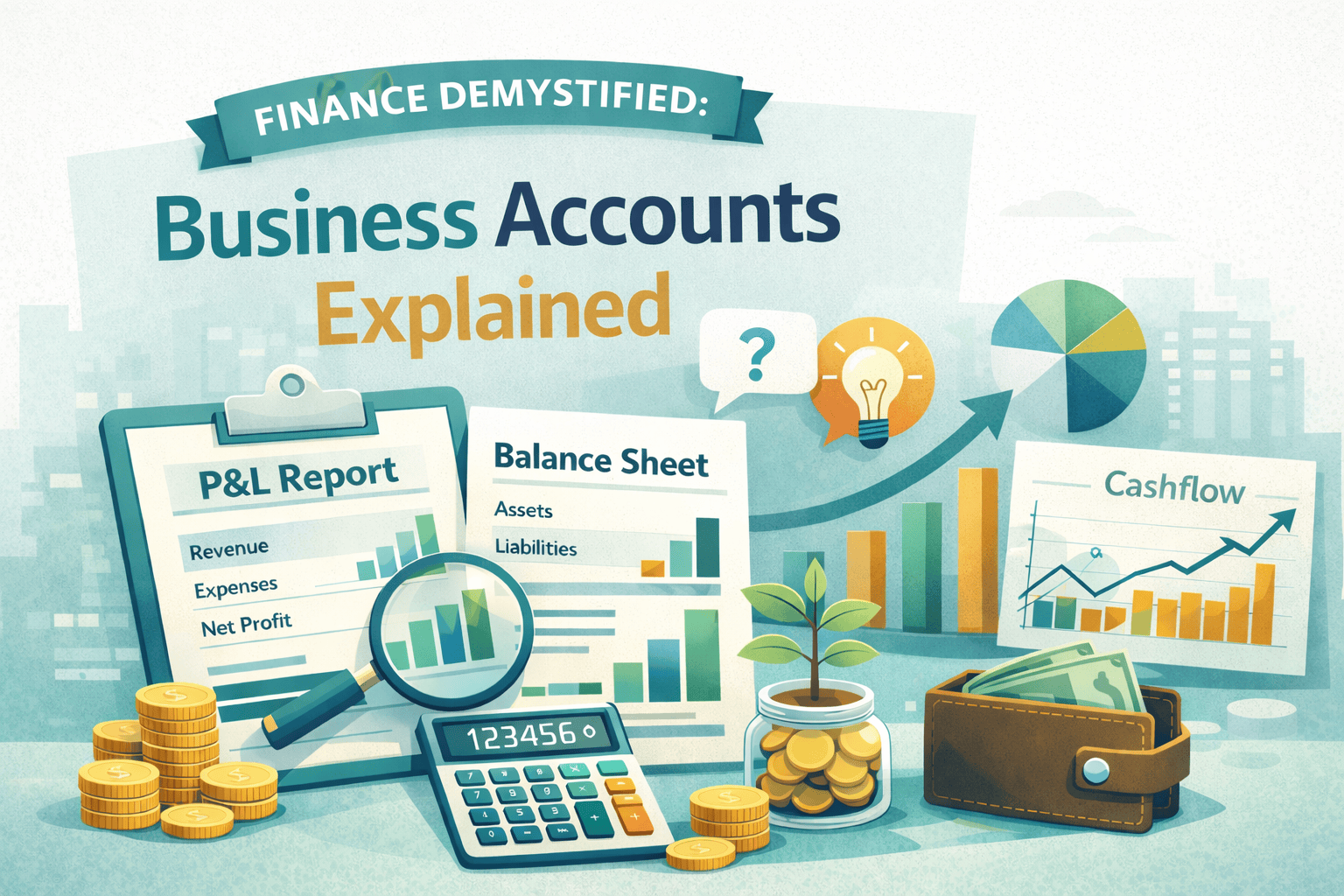
How to use your financial reports, even if you’re not an accountant
Business owners don’t start a company because they love accounts
If you find your accounts confusing, you are not alone. This guide explains business accounts explained in plain English, helping business owners and finance managers turn reports into practical insight.
Most business owners, and many newer or non-qualified finance managers, struggle to extract meaning from financial reports. Year-end statutory accounts (often referred to as “stat accounts”) are produced primarily for compliance, not for decision-making. As a result, they are full of unfamiliar terminology, formatting conventions, and accounting adjustments that make it difficult to answer the one question that really matters:
“How are we actually doing?”
Many SMEs operate without an in-house finance team and rely on an external accountant once a year. That approach meets legal obligations, but it misses the real value of financial information. The power of your numbers lies in how you use them throughout the year to guide decisions, manage risk, and plan with confidence, not just to look backwards after the year end.
This guide is designed to help you understand what your accounts are really telling you, in plain English. Whether you are a business owner seeking greater control, or a finance lead without formal training, the aim is to turn your reports into practical business insight.
1. The Profit & Loss (P&L): are we making money in the right way?
The Profit & Loss account (also called the income statement) shows how much income your business generated over a period, what it cost to deliver that income, and what remains after all expenses.
A typical P&L includes:
- Turnover / Revenue – what you invoiced, adjusted for what you actually delivered (the ‘accruals’ concept)
- Cost of Sales – costs directly linked to delivery (e.g. subcontractors, materials, delivery/client facing staff), sometimes referred to as COGS
- Gross Profit – profit before overheads; the margin on the sales
- Operating Expenses / Overheads – fixed or semi-fixed costs such as admin salaries, rent, software, and marketing
- Net Profit – what is left after all costs, before or after tax
Revenue growth alone does not mean a business is healthy. Sustainable businesses grow profitably. Your P&L helps you assess this by highlighting:
- Margins – Is your gross margin stable or declining? A fall may indicate rising costs or under-pricing.
- Scalability – Are overheads increasing faster than income?
- Seasonality – Are peaks and troughs expected, or signs of instability?
Trend analysis is key. Ask questions such as:
- Are delivery costs rising as the business grows?
- Are admin costs being absorbed by growth, or eroding profit?
- Are you doing more work for the same return?
A business can be busy, even growing, and still be unprofitable. The P&L is where you see whether growth is creating value or quietly destroying margin.
For service businesses, revenue per team member is often a critical metric. For product-based businesses, focus on unit economics and gross margin per product.
2. The Balance Sheet: how financially strong are we, really?
The balance sheet shows what your business owns, what it owes, and its net worth at a specific point in time. Unlike the P&L, which covers a period, the balance sheet is a snapshot, a freeze-frame of financial position.
It typically includes:
- Assets: cash, invoices owed to you (debtors), stock, equipment
- Liabilities: supplier bills (creditors), VAT, PAYE, loans, taxes due
- Net Current Assets / Liabilities: whether the business can meet short-term obligations
- Equity: the accumulated value of the business, including retained profits
Many SMEs overlook the balance sheet because the language feels opaque. In practice, it provides some of the most important warning signals:
- Is your cash position improving or deteriorating?
- Are debtors increasing faster than sales?
- Do creditors indicate good cash management, or pressure?
- Is stock tying up cash unnecessarily?
Crucially, the balance sheet tells you whether the business is solvent (able to meet its obligations), not just profitable.
Credit rating agencies and lenders rely heavily on balance sheet data filed at Companies House. Poor balance sheet health can directly affect access to finance, often without the business owner realising why.
A clearer view of reserves and dividends
One of the most misunderstood balance sheet areas is retained earnings (also called reserves).
This represents accumulated profits after tax and after dividends. Think of it as the company’s internal savings account. Even if there is £50,000 in the bank, a company with negative retained earnings cannot legally pay dividends.
Profit, cash, and dividend availability are three different things.
Distributing dividends without checking reserves can lead to:
- Overdrawn director’s loan accounts
- Unexpected personal tax liabilities
- Red flags in funding or due-diligence processes
Before taking dividends, always confirm:
- Has the company generated post-tax profits?
- Are those profits reflected in retained earnings?
- Will the dividend leave reserves positive?
A basic understanding here protects both the business and the owner personally.
3. Cashflow: can we afford what’s coming?
Cashflow statements are not included as standard in small company accounts, but that doesn’t mean it shouldn’t form part of the annual review conversation.
Cashflow tracks the actual movement of money in and out of the business. Many profitable SMEs fail because of cashflow gaps, particularly during periods of growth.
Common pressure points include:
- Client payment delays
- Rapidly increasing VAT liabilities
- Annual or one-off costs (software, insurance, bonuses)
- Hiring ahead of confirmed revenue
A business can be profitable on paper and still be unable to pay wages, suppliers, or tax. That quickly becomes an operational crisis.
This is why rolling 13-week cashflow forecasts are so valuable. They are short enough to manage, but long enough to spot issues early.
If you would not drive without a fuel gauge, do not run a business without a forward view of cash.
Effective cashflow tracking allows you to:
- Plan major spending decisions
- Time VAT and PAYE payments
- Assess when dividends are affordable
- Reduce stress and uncertainty
4. Metrics that matter
You do not need dozens of KPIs. For most SMEs, tracking five to seven core metrics monthly provides clarity. Below are some metrics followed by an explanation of what they show us:
Gross margin %: Delivery efficiency before overheads
Net Profit %: Overall profitability
Debtor Days: How quickly customers pay (target: under 45 days)
Current Ratio: Short-term financial resilience (target: above 1.2)
Cash Runway: How long the business can operate without new sales
Revenue per Head: Productivity in service businesses
Stock Turnover: Efficiency of stock conversion (product businesses)
These act as early-warning indicators:
-
Falling gross margin may indicate pricing or cost issues
-
Rising debtor days point to credit control problems
-
A shrinking cash runway signals the need to slow investment
They also support benchmarking, fundraising, and eventual exit planning.
5. Using your accounts to make better decisions
Understanding your accounts is not about numbers, it is about action.
Your reports should help answer practical questions such as:
- Can we increase prices without damaging demand?
- Can we afford another hire?
- Is it safe to take money out of the business?
- Should we invest in systems, premises, or equipment?
- Are we growing well, or just getting busier?
Too many decisions are made on instinct alone. Even basic financial insight turns gut feel into confident, evidence-based judgement.
Business accounts explained: you don’t need a finance team to think financially
Financial understanding is not about jargon or technical compliance. It is about clarity and control.
When you understand what your accounts are really telling you:
- You become proactive rather than reactive.
- You reduce surprises and stress.
- You lead with confidence, even without a full finance function.
You do not need to know every accounting rule. You do need to know what the numbers mean and how to act on them.
If you want business accounts explained clearly and without jargon, we can help
Download our free Metrics Tracker: a simple tool to monitor what really matters each month.
This blog is for general information only and does not constitute professional advice. Always seek tailored advice relevant to your specific circumstances.
https://graspaccountants.co.uk/wp-content/uploads/2025/12/Financial-Metrics-Tracker-Download.pdf